Warmest places to go from Copenhagen in April
In April, the warmest well-known place within 15 hours of Copenhagen is Aswan, Egypt, averaging 28.1 °C across day and night and 11.8 h sun a day, about 8h 42m each way by air. Without flying, it is Bratislava, Slovakia, averaging 10.8 °C across day and night, about 14h 54m each way by train, for about 35× less carbon (26.3 kg CO₂e return against 909 kg).
Every city at once, with and without flying: where is hot in April.
The 10 warmest places within 15 hours of Copenhagen
Ranked on warmth in April alone, among well-known places (a Wikivoyage travel guide and at least 40,000 Wikipedia readers a year), one per area and at most three per country. The carbon is shown, not used to choose: the list further down is the other question, how much warmth each extra kilogram buys.
 Aswan, Egypt28.1 °C · 11.8 h sun a day · mostly dryair ≈ 8h 42m · 909 kg CO₂e return
 Luxor, Egypt27.4 °C · 11.8 h sun a day · mostly dryair ≈ 8h 24m · 868 kg CO₂e return
 Sharm el-Sheikh, Egypt27.3 °C · 11.9 h sun a day · mostly dry · sea 23.2 °Cair ≈ 8h 12m · 891 kg CO₂e return
 Aqaba, Jordan25.2 °C · 11.7 h sun a day · mostly dry · sea 22.2 °Cair ≈ 8h · 857 kg CO₂e return
 Maspalomas, Spain22.1 °C · 11.9 h sun a day · mostly dry · sea 20.5 °Cair ≈ 8h 36m · 897 kg CO₂e return
 Marrakesh, Morocco21.7 °C · 11.5 h sun a day · mostly dryair ≈ 7h 42m · 784 kg CO₂e return
 Ouarzazate, Morocco20.8 °C · 12.2 h sun a day · mostly dryair ≈ 7h 42m · 792 kg CO₂e return
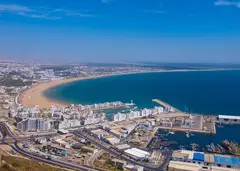 Agadir, Morocco20.2 °C · 12.1 h sun a day · mostly dry · sea 18.5 °Cair ≈ 7h 54m · 831 kg CO₂e return
 Las Palmas de Gran Canaria, Spain20.1 °C · 11.6 h sun a day · mostly dry · sea 20.5 °Cair ≈ 8h 36m · 887 kg CO₂e return
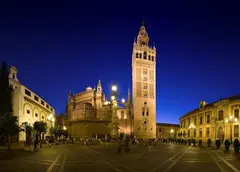 Seville, Spain19.8 °C · 11.8 h sun a day · mostly dryair ≈ 6h 48m · 619 kg CO₂e return
Without flying
The warmest places the train reaches within 15 hours. Bratislava is 10.8 °C for 26.3 kg — about 35× less carbon than flying to Aswan.
 Bratislava, Slovakia10.8 °C · 9.4 h sun a day · 2.3 mm rain a dayrail ≈ 14h 54m · 26.3 kg CO₂e return
 Vienna, Austria10.5 °C · 8.8 h sun a day · 3.1 mm rain a dayrail ≈ 14h 36m · 25.7 kg CO₂e return
 Nitra, Slovakia10.5 °C · 9.7 h sun a day · 2.2 mm rain a dayrail ≈ 15h · 26.6 kg CO₂e return
- Karlsruhe, Germany10.2 °C · 8.9 h sun a day · 3.0 mm rain a dayrail ≈ 13h 18m · 23.4 kg CO₂e return
 Strasbourg, France10.0 °C · 9.1 h sun a day · 3.7 mm rain a dayrail ≈ 13h 54m · 25.2 kg CO₂e return
 Heidelberg, Germany9.8 °C · 8.6 h sun a day · 3.4 mm rain a dayrail ≈ 12h 42m · 22.0 kg CO₂e return
≈ is the model's estimate (air times include getting to and through the airport); ✓ is a rail journey checked against a real timetable, with the date it was checked. Temperatures are historical daily means for 2023–2024, averaged across day and night, so afternoons run warmer.
The low-carbon trade-off
The warmest place you can reach from Copenhagen in April within 15 hours is Kom Ombo, 28.3 °C, costing 900 kg CO₂e return. The lowest-carbon option is Karlshamn at 4.5 kg — 200× less carbon, for 22.1 degrees less warmth.
Every destination here is on the efficiency frontier: nowhere else this site covers is both warmer in April and lower in carbon. Anything a better option beats outright has been left out.
By rail or ferry By air
What the 15-hour limit costs: at this budget Nice can only be reached by air — 348 kg CO₂e, in 5h 18m. Allow up to 24 hours and the train does the same journey for 40.8 kg in 22h — 9× less carbon for 16h 42m more travelling.
| Destination | How | CO₂e return | Temp | Sun/day | Rain/day | Journey |
|---|---|---|---|---|---|---|
| Karlshamn, Sweden | Rail | 4.5 kg | 6.2 °C | 9.5 h | 1.2 mm | 4h 12m |
| Stralsund, Germany | Rail | 4.6 kg | 7.8 °C | 9.0 h | 2.4 mm | 4h 12m |
| Rostock, Germany | Rail | 5.3 kg | 8.1 °C | 8.8 h | 2.7 mm | 4h 36m |
| Szczecin, Poland | Rail | 8.3 kg | 8.9 °C | 8.2 h | 1.6 mm | 6h 6m |
| Koenigs Wusterhausen, Germany | Rail | 11.3 kg | 9.8 °C | 8.4 h | 1.7 mm | 7h 30m |
| Trnava, Slovakia | Rail | 26.0 kg | 11.1 °C | 9.5 h | 2.5 mm | 14h 42m |
| Trieste, Italy | Air | 281 kg | 12.7 °C | 9.5 h | 3.3 mm | 5h |
| Milan, Italy | Air | 292 kg | 13.1 °C | 10.3 h | 2.9 mm | 5h |
| Nice, France | Air | 348 kg | 14.4 °C | 11.3 h | 1.5 mm | 5h 18m |
| Cannes, France | Air | 353 kg | 14.7 °C | 11.4 h | 1.6 mm | 5h 24m |
| Trani, Italy | Air | 409 kg | 15.5 °C | 10.5 h | 2.1 mm | 5h 42m |
| Lleida, Spain | Air | 450 kg | 16.3 °C | 11.4 h | 0.6 mm | 5h 54m |
| Alzira, Spain | Air | 522 kg | 18.2 °C | 11.5 h | 0.1 mm | 6h 18m |
| Kairouan, Tunisia | Air | 561 kg | 18.6 °C | 10.6 h | 0.8 mm | 6h 30m |
| Palma del Rio, Spain | Air | 604 kg | 20.0 °C | 11.9 h | 0.4 mm | 6h 42m |
| Tozeur, Tunisia | Air | 615 kg | 21.3 °C | 10.8 h | 0.6 mm | 6h 48m |
| Recani, Morocco | Air | 758 kg | 23.2 °C | 11.7 h | 0.0 mm | 7h 30m |
| Aqaba, Jordan | Air | 857 kg | 25.2 °C | 11.7 h | 0.2 mm | 8h |
| Luxor, Egypt | Air | 868 kg | 27.4 °C | 11.8 h | 0.0 mm | 8h 24m |
| Kom Ombo, Egypt | Air | 900 kg | 28.3 °C | 11.8 h | 0.0 mm | 8h 36m |
Warm is not the same as pleasant, which is why sunshine and rainfall are shown alongside temperature. All three are ERA5 monthly means for 2023–2024.
Where the curve breaks
The frontier is gentle until it isn't. Going from Trnava (26.0 kg, 11.1 °C) to Trieste (281 kg, 12.7 °C) buys 1.6 °C more warmth for an extra 255 kg — 160 kg of CO₂e per degree. That single step is the most expensive warmth on the whole curve.
The pick of them
 KarlshamnSweden4.5 kg CO₂e returncold but bright
 TrnavaSlovakia26.0 kg CO₂e returnmild and bright
 Kom OmboEgypt900 kg CO₂e returnwarm, bright and dry
The same month, asked differently
April answers differently depending on what you are after, and the lists genuinely diverge: the brightest places are not the hottest, and in summer the useful question stops being where is warm at all.
Where to stay in Kom Ombo
Places to stay in Kom Ombo, Egypt, on a live map. Prices and availability come from Stay22 and its booking partners.
Search places to stay in Kom Ombo →Opens the booking search in a new tab. Same partners as the map below.
Affiliate disclosure. A booking made through this map may earn 0xCarbon a commission, at no extra cost to you. It changes nothing above it: the emissions figures come from UK Government conversion factors and are computed before anyone is paid anything.See the method.
Other months from Copenhagen
April from elsewhere
- Amsterdam
- Barcelona
- Berlin
- Birmingham
- Bristol
- Brussels
- Cardiff
- Copenhagen
- Dublin
- Edinburgh
- Frankfurt
- Glasgow
- Leeds
- Lisbon
- Liverpool
- London
- Madrid
- Manchester
- Milan
- Munich
- Newcastle
- Nottingham
- Oslo
- Paris
- Prague
- Rome
- Sheffield
- Southampton
- Stockholm
- Vienna
- Warsaw
- Zurich
Photo credits
- Karlshamn: Entheta, CC BY-SA 3.0, via Wikimedia Commons
- Trnava: Pavel Briatka, CC BY-SA 2.5, via Wikimedia Commons
- Kom Ombo: Jerzy Strzelecki, CC BY-SA 3.0, via Wikimedia Commons
- Aswan: Vyacheslav Argenberg, CC BY 4.0, via Wikimedia Commons
- Luxor: Roland Unger, CC BY-SA 3.0, via Wikimedia Commons
- Sharm el-Sheikh: Tanya Dedyukhina, CC BY 3.0, via Wikimedia Commons
- Aqaba: Sana Janakat, CC BY-SA 4.0, via Wikimedia Commons
- Maspalomas: JUAN RAMON RODRIGUEZ SOSA, CC BY-SA 2.0, via Wikimedia Commons
- Marrakesh: Donar Reiskoffer, CC BY 3.0, via Wikimedia Commons
- Ouarzazate: Bjørn Christian Tørrissen, CC BY-SA 3.0, via Wikimedia Commons
- Agadir: Marco Riss, CC BY-SA 3.0, via Wikimedia Commons
- Las Palmas de Gran Canaria: Bengt Nyman, CC BY-SA 4.0, via Wikimedia Commons
- Seville: Diliff, CC BY-SA 3.0, via Wikimedia Commons
- Bratislava: Rob Hurson from Kentstown, Ireland, CC BY-SA 2.0, via Wikimedia Commons
- Vienna: Andrzej Otrębski, CC BY-SA 4.0, via Wikimedia Commons
- Nitra: unknown author, CC BY-SA 3.0, via Wikimedia Commons
- Strasbourg: Radek Kucharski, CC BY 2.0, via Wikimedia Commons
- Heidelberg: Miholz, CC BY-SA 3.0, via Wikimedia Commons


.jpg)


.jpg)


Questions
Where is the warmest place to go from Copenhagen in April?
Kom Ombo, Egypt, at 28.3 °C. Reaching it emits 900 kg CO₂e return, travelling 8h 36m each way by air (modelled).
Can I get somewhere warm from Copenhagen in April without flying?
Yes. Trnava reaches 11.1 °C and is reachable by rail or ferry in 14h 42m (modelled), emitting 26.0 kg CO₂e return — though Kom Ombo is warmer still, if you fly.
How much carbon does a return trip from Copenhagen to Kom Ombo produce?
900 kg CO₂e for one person, return, by air. That uses the UK Government's 2026 conversion factors, including radiative forcing for flights.
Carbon uses UK Government (DESNZ/DEFRA) 2026 conversion factors applied to great-circle distance, with radiative forcing included for flights. Rail journey times are modelled estimates, not timetabled services. Full method · download the data.