Dresden

Reaching Dresden from London emits 28.5 kg CO₂e return by rail (14h 12m each way) against 243 kg by air — 9× the carbon. It averages 20.6 °C in July and 2.5 °C in January.
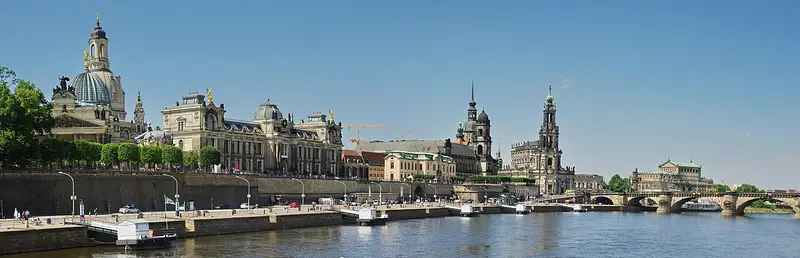
Dresden is the capital of Saxony (Sachsen). — Wikivoyage, CC BY-SA 4.0
When to go: Dresden is warmest in July (20.6 °C), sunniest in June (13.0 h a day); coldest in January (2.5 °C). Month by month
Getting there
| From | Distance | By rail | Rail time | By air | Air time |
|---|---|---|---|---|---|
| Amsterdam | 627 km | 18.5 kg | 10h 12m | 158 kg | 4h 18m |
| Barcelona | 1,392 km | 41.1 kg | 19h 12m | 350 kg | 5h 24m |
| Berlin | 165 km | 4.9 kg | 3h 24m | 41.6 kg | 3h 42m |
| Birmingham | 1,086 km | 41.5 kg | 17h | 273 kg | 4h 54m |
| Bristol | 1,135 km | 42.2 kg | 17h 12m | 286 kg | 5h |
| Brussels | 658 km | 19.4 kg | 10h 30m | 165 kg | 4h 24m |
| Cardiff | 1,175 km | 45.4 kg | 17h 30m | 296 kg | 5h 6m |
| Copenhagen | 520 km | 15.3 kg | 9h 30m | 131 kg | 4h 12m |
| Dublin | 1,381 km | — | — | 347 kg | 5h 18m |
| Edinburgh | 1,241 km | 71.4 kg | 20h | 312 kg | 5h 12m |
| Frankfurt | 372 km | 11.0 kg | 6h 30m | 93.5 kg | 4h |
| Glasgow | 1,301 km | 73.1 kg | 20h 6m | 327 kg | 5h 12m |
| Leeds | 1,078 km | 50.3 kg | 17h 48m | 271 kg | 4h 54m |
| Lisbon | 2,249 km | 66.4 kg | 34h 30m | 566 kg | 6h 30m |
| Liverpool | 1,165 km | 51.5 kg | 17h 48m | 293 kg | 5h 6m |
| London | 964 km | 28.5 kg | 14h 12m | 243 kg | 4h 48m |
| Madrid | 1,789 km | 52.8 kg | 22h 48m | 450 kg | 5h 54m |
| Manchester | 1,118 km | 49.5 kg | 17h 42m | 281 kg | 5h |
| Milan | 706 km | 20.8 kg | 12h 12m | 178 kg | 4h 24m |
| Munich | 359 km | 10.6 kg | 6h 42m | 90.4 kg | 4h |
| Newcastle | 1,113 km | 60.4 kg | 18h 30m | 280 kg | 5h |
| Nottingham | 1,039 km | 42.5 kg | 17h 18m | 261 kg | 4h 54m |
| Oslo | 1,003 km | 29.6 kg | 16h 30m | 252 kg | 4h 48m |
| Paris | 850 km | 25.1 kg | 11h 6m | 214 kg | 4h 36m |
| Rome | 1,023 km | 30.2 kg | 15h 30m | 257 kg | 4h 54m |
| Sheffield | 1,066 km | 46.7 kg | 17h 36m | 268 kg | 4h 54m |
| Southampton | 1,058 km | 37.4 kg | 16h 54m | 266 kg | 4h 54m |
| Stockholm | 960 km | 28.3 kg | 14h 24m | 242 kg | 4h 48m |
| Vienna | 369 km | 10.9 kg | 7h 24m | 92.7 kg | 4h |
| Warsaw | 519 km | 15.3 kg | 8h 54m | 130 kg | 4h 12m |
| Zurich | 556 km | 16.4 kg | 10h | 140 kg | 4h 12m |
The year in Dresden
| Jan | Feb | Mar | Apr | May | Jun | Jul | Aug | Sep | Oct | Nov | Dec | |
|---|---|---|---|---|---|---|---|---|---|---|---|---|
| Temp °C | 2.5 | 5.0 | 6.9 | 9.3 | 14.6 | 18.5 | 20.6 | 20.5 | 17.2 | 12.2 | 5.3 | 3.4 |
| Sun h/day | 3.2 | 4.3 | 6.9 | 8.5 | 11.1 | 13.0 | 12.5 | 10.5 | 9.6 | 6.4 | 4.2 | 3.5 |
| Rain mm/day | 2.2 | 2.8 | 1.8 | 1.9 | 1.4 | 2.8 | 2.3 | 2.7 | 2.4 | 2.4 | 2.7 | 2.4 |
When to go
Dresden is warmest in July at 20.6 °C but brightest in June, averaging 13.0 hours of sun a day — the two do not always coincide, which is worth knowing before booking. Its coldest is January at 2.5 °C.
Three months worth booking
The same year of measurements, decided rather than tabulated. Each opens the map below on dates in that month.
Staying there
A hotel room in Germany emits about 13.2 kg CO₂e per night under UK Government 2026 factors — a country average per occupied room, not this or any particular hotel. 7 nights in one room adds roughly 92 kg — about 18.9× the carbon of one person getting there by rail from Berlin. Two sharing the room halve that share each; the journey does not halve.
How busy it gets
Dresden, Kreisfreie Stadt records 8.2 overnight stays per resident a year (4,606,893 nights in 2024). A well-visited region, busy in season but not overwhelmed.
Eurostat, nights spent at tourist accommodation by NUTS 3 region, against resident population. Shown for context only — it plays no part in which destinations appear or in what order. Eurostat does not cover the United Kingdom after 2016, nor North Africa or the Levant at all, so this figure is absent for roughly a third of the destinations here.
Where to stay in Dresden
Places to stay in Dresden, Germany, on a live map. Prices and availability come from Stay22 and its booking partners.
Search places to stay in Dresden →Opens the booking search in a new tab. Same partners as the map below.
Affiliate disclosure. A booking made through this map may earn 0xCarbon a commission, at no extra cost to you. It changes nothing above it: the emissions figures come from UK Government conversion factors and are computed before anyone is paid anything.See the method.
Distances are great-circle. Rail assumes international rail at 0.01135 kg CO₂e per passenger-km with a 1.3× track detour allowance; flights use 0.12576 kg per passenger-km including radiative forcing. Journey times are modelled, not timetabled. Full method.