Sousse
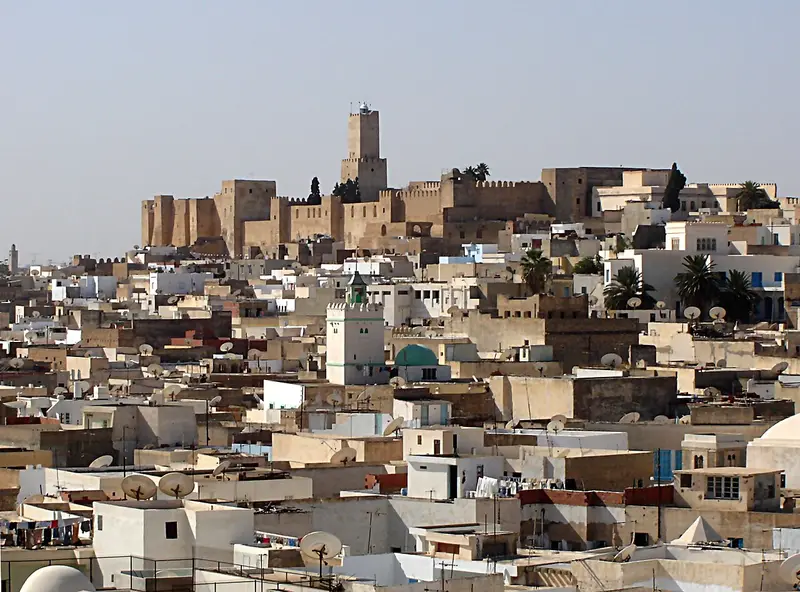

Sousse is not costed by rail here: no through rail connection is modelled, and no verified rail or sea itinerary is included in this comparison. By air it is 489 kg CO₂e return from London. It averages 30.3 °C in July and 12.9 °C in January.
Sousse is one of the older cities in Tunisia, possessing an authentic medina, which has been declared a UNESCO World Heritage Site. — Wikivoyage, CC BY-SA 4.0
When to go: Sousse is warmest in July (30.3 °C); coldest in January (12.9 °C). Month by month
Getting there
Travel advice for Tunisia. FCDO advises against all travel or all but essential travel to specified border, mountain and military-operation areas. gov.uk advice, page updated 24 July 2026; read 2026-09-15. Whether Sousse itself is inside an affected area is not assessed here; check the page before booking.
| From | Distance | By rail | Rail time | By air | Air time |
|---|---|---|---|---|---|
| Amsterdam | 1,895 km | — | — | 477 kg | 6h |
| Barcelona | 961 km | — | — | 242 kg | 4h 48m |
| Berlin | 1,870 km | — | — | 470 kg | 6h |
| Birmingham | 2,098 km | — | — | 528 kg | 6h 18m |
| Bristol | 2,031 km | — | — | 511 kg | 6h 12m |
| Brussels | 1,745 km | — | — | 439 kg | 5h 48m |
| Cardiff | 2,058 km | — | — | 518 kg | 6h 12m |
| Copenhagen | 2,212 km | — | — | 556 kg | 6h 24m |
| Dublin | 2,349 km | — | — | 591 kg | 6h 36m |
| Edinburgh | 2,470 km | — | — | 621 kg | 6h 48m |
| Frankfurt | 1,597 km | — | — | 402 kg | 5h 36m |
| Glasgow | 2,497 km | — | — | 628 kg | 6h 48m |
| Leeds | 2,210 km | — | — | 556 kg | 6h 24m |
| Lisbon | 1,777 km | — | — | 447 kg | 5h 54m |
| Liverpool | 2,224 km | — | — | 559 kg | 6h 30m |
| London | 1,942 km | — | — | 489 kg | 6h 6m |
| Madrid | 1,352 km | — | — | 340 kg | 5h 18m |
| Manchester | 2,204 km | — | — | 554 kg | 6h 24m |
| Milan | 1,079 km | — | — | 271 kg | 4h 54m |
| Munich | 1,371 km | — | — | 345 kg | 5h 18m |
| Newcastle | 2,326 km | — | — | 585 kg | 6h 36m |
| Nottingham | 2,116 km | — | — | 532 kg | 6h 18m |
| Oslo | 2,678 km | — | — | 674 kg | 7h 6m |
| Paris | 1,599 km | — | — | 402 kg | 5h 36m |
| Prague | 1,615 km | — | — | 406 kg | 5h 42m |
| Rome | 694 km | — | — | 175 kg | 4h 24m |
| Sheffield | 2,168 km | — | — | 545 kg | 6h 24m |
| Southampton | 1,933 km | — | — | 486 kg | 6h 6m |
| Stockholm | 2,668 km | — | — | 671 kg | 7h 6m |
| Vienna | 1,455 km | — | — | 366 kg | 5h 24m |
| Warsaw | 1,999 km | — | — | 503 kg | 6h 12m |
| Zurich | 1,295 km | — | — | 326 kg | 5h 12m |
The year in Sousse
| Jan | Feb | Mar | Apr | May | Jun | Jul | Aug | Sep | Oct | Nov | Dec | |
|---|---|---|---|---|---|---|---|---|---|---|---|---|
| Temp °C | 12.9 | 13.2 | 16.4 | 17.6 | 20.4 | 25.3 | 30.3 | 28.6 | 26.4 | 23.5 | 18.3 | 13.6 |
| Sun h/day | 8.5 | 8.5 | 10.6 | 10.7 | 11.1 | 12.2 | 13.1 | 12.6 | 10.8 | 9.4 | 9.3 | 7.9 |
| Rain mm/day | 0.2 | 1.6 | 0.3 | 1.2 | 1.8 | 0.5 | 0.0 | 0.3 | 1.0 | 1.1 | 0.8 | 1.9 |
| Sea °C | 17.6 | 15.9 | 16.0 | 17.2 | 19.0 | 22.4 | 26.3 | 28.0 | 26.9 | 25.0 | 22.9 | 19.7 |
When to go
Sousse is warmest in July at 30.3 °C, and that is also its brightest month. Its coldest is January at 12.9 °C.
On these lists
Three months worth booking
The same year of measurements, decided rather than tabulated. Each opens the map below on dates in that month.
Where to stay in Sousse
Places to stay in Sousse, Tunisia, on a live map. Prices and availability come from Stay22 and its booking partners.
Search places to stay in Sousse →Opens the booking search in a new tab. Same partners as the map below.
Affiliate disclosure. A booking made through this map may earn 0xCarbon a commission, at no extra cost to you. It changes nothing above it: the emissions figures come from UK Government conversion factors and are computed before anyone is paid anything.See the method.
Distances are great-circle. Rail assumes international rail at 0.01135 kg CO₂e per passenger-km with a 1.3× track detour allowance; flights use 0.12576 kg per passenger-km including radiative forcing. Journey times are modelled, not timetabled. Full method.