Sidi Ifni
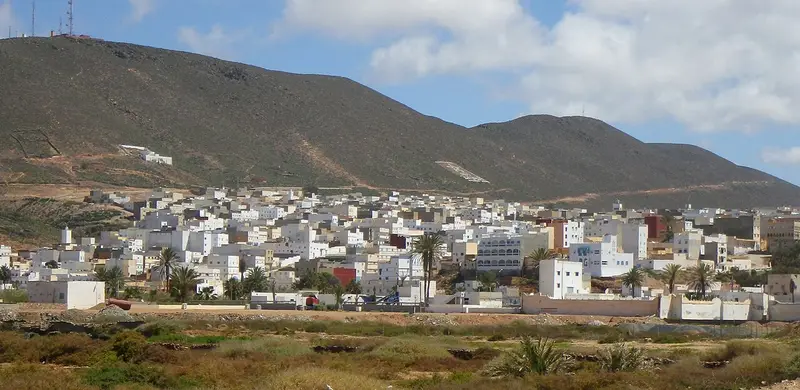

Sidi Ifni is not costed by rail here: no through rail connection is modelled, and no verified rail or sea itinerary is included in this comparison. By air it is 653 kg CO₂e return from London. It averages 22.6 °C in August and 16.9 °C in February.
Sidi Ifni is a fishing town in the northern coastal part of Anti Atlas built by the Spanish in Art Deco style. — Wikivoyage, CC BY-SA 4.0
When to go: Sidi Ifni is warmest in August (22.6 °C), sunniest in April (11.1 h a day); coldest in February (16.9 °C). Month by month
Getting there
| From | Distance | By rail | Rail time | By air | Air time |
|---|---|---|---|---|---|
| Amsterdam | 2,840 km | — | — | 714 kg | 7h 18m |
| Barcelona | 1,738 km | — | — | 437 kg | 5h 48m |
| Berlin | 3,217 km | — | — | 809 kg | 7h 48m |
| Birmingham | 2,657 km | — | — | 668 kg | 7h |
| Bristol | 2,534 km | — | — | 637 kg | 6h 54m |
| Brussels | 2,677 km | — | — | 673 kg | 7h 6m |
| Cardiff | 2,525 km | — | — | 635 kg | 6h 54m |
| Copenhagen | 3,433 km | — | — | 863 kg | 8h 6m |
| Dublin | 2,683 km | — | — | 675 kg | 7h 6m |
| Edinburgh | 3,006 km | — | — | 756 kg | 7h 30m |
| Frankfurt | 2,796 km | — | — | 703 kg | 7h 12m |
| Glasgow | 2,982 km | — | — | 750 kg | 7h 30m |
| Leeds | 2,803 km | — | — | 705 kg | 7h 12m |
| Lisbon | 1,043 km | — | — | 262 kg | 4h 54m |
| Liverpool | 2,735 km | — | — | 688 kg | 7h 6m |
| London | 2,598 km | — | — | 653 kg | 7h |
| Madrid | 1,361 km | — | — | 342 kg | 5h 18m |
| Manchester | 2,756 km | — | — | 693 kg | 7h 12m |
| Milan | 2,461 km | — | — | 619 kg | 6h 48m |
| Munich | 2,792 km | — | — | 702 kg | 7h 12m |
| Newcastle | 2,927 km | — | — | 736 kg | 7h 24m |
| Nottingham | 2,723 km | — | — | 685 kg | 7h 6m |
| Oslo | 3,740 km | — | — | 876 kg | 8h 30m |
| Paris | 2,413 km | — | — | 607 kg | 6h 42m |
| Prague | 3,090 km | — | — | 777 kg | 7h 36m |
| Rome | 2,465 km | — | — | 620 kg | 6h 48m |
| Sheffield | 2,761 km | — | — | 695 kg | 7h 12m |
| Southampton | 2,503 km | — | — | 629 kg | 6h 48m |
| Stockholm | 3,954 km | — | — | 926 kg | 8h 48m |
| Vienna | 3,082 km | — | — | 775 kg | 7h 36m |
| Warsaw | 3,602 km | — | — | 906 kg | 8h 18m |
| Zurich | 2,567 km | — | — | 646 kg | 6h 54m |
The year in Sidi Ifni
| Jan | Feb | Mar | Apr | May | Jun | Jul | Aug | Sep | Oct | Nov | Dec | |
|---|---|---|---|---|---|---|---|---|---|---|---|---|
| Temp °C | 17.5 | 16.9 | 18.0 | 19.5 | 18.5 | 20.2 | 21.2 | 22.6 | 21.0 | 22.5 | 21.4 | 17.8 |
| Sun h/day | 9.4 | 9.1 | 10.6 | 11.1 | 10.8 | 9.5 | 10.5 | 10.4 | 10.2 | 9.9 | 9.6 | 9.0 |
| Rain mm/day | 0.1 | 1.7 | 0.7 | 1.0 | 1.3 | 1.7 | 0.3 | 0.2 | 0.3 | 0.6 | 0.2 | 0.6 |
| Sea °C | 18.8 | 17.6 | 17.6 | 19.0 | 18.5 | 20.2 | 20.2 | 21.0 | 21.1 | 21.6 | 19.9 | 19.5 |
When to go
Sidi Ifni is warmest in August at 22.6 °C but brightest in April, averaging 11.1 hours of sun a day — the two do not always coincide, which is worth knowing before booking. Its coldest is February at 16.9 °C.
Three months worth booking
The same year of measurements, decided rather than tabulated. Each opens the map below on dates in that month.
Where to stay in Sidi Ifni
Places to stay in Sidi Ifni, Morocco, on a live map. Prices and availability come from Stay22 and its booking partners.
Search places to stay in Sidi Ifni →Opens the booking search in a new tab. Same partners as the map below.
Affiliate disclosure. A booking made through this map may earn 0xCarbon a commission, at no extra cost to you. It changes nothing above it: the emissions figures come from UK Government conversion factors and are computed before anyone is paid anything.See the method.
Distances are great-circle. Rail assumes international rail at 0.01135 kg CO₂e per passenger-km with a 1.3× track detour allowance; flights use 0.12576 kg per passenger-km including radiative forcing. Journey times are modelled, not timetabled. Full method.