Písek

Reaching Písek from London emits 30.7 kg CO₂e return by rail (15h 12m each way) against 261 kg by air — 9× the carbon. It averages 20.3 °C in July and 1.1 °C in January.
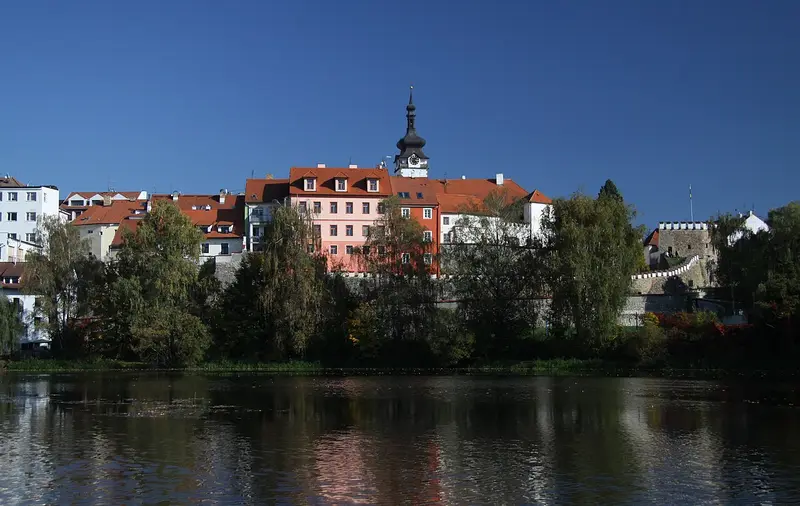
Písek (pronounced Peesek) is a town in South Bohemia, known for having the oldest stone bridge in the Czech Republic. — Wikivoyage, CC BY-SA 4.0
When to go: Písek is warmest in July (20.3 °C); coldest in January (1.1 °C). Month by month
Getting there
| From | Distance | By rail | Rail time | By air | Air time |
|---|---|---|---|---|---|
| Amsterdam | 733 km | 21.6 kg | 12h 18m | 184 kg | 4h 30m |
| Barcelona | 1,283 km | 37.9 kg | 19h 6m | 323 kg | 5h 12m |
| Berlin | 361 km | 10.7 kg | 7h 12m | 90.9 kg | 4h |
| Birmingham | 1,177 km | 43.7 kg | 17h 54m | 296 kg | 5h 6m |
| Bristol | 1,208 km | 44.4 kg | 18h 12m | 304 kg | 5h 6m |
| Brussels | 719 km | 21.2 kg | 11h 30m | 181 kg | 4h 30m |
| Cardiff | 1,249 km | 47.6 kg | 18h 30m | 314 kg | 5h 12m |
| Copenhagen | 716 km | 21.1 kg | 12h 18m | 180 kg | 4h 30m |
| Dublin | 1,480 km | — | — | 372 kg | 5h 30m |
| Edinburgh | 1,378 km | 73.6 kg | 20h 54m | 347 kg | 5h 18m |
| Frankfurt | 403 km | 11.9 kg | 7h 48m | 101 kg | 4h |
| Glasgow | 1,435 km | 75.3 kg | 21h 6m | 361 kg | 5h 24m |
| Leeds | 1,191 km | 52.5 kg | 18h 48m | 300 kg | 5h 6m |
| Lisbon | 2,190 km | 64.6 kg | 33h 36m | 551 kg | 6h 24m |
| Liverpool | 1,270 km | 53.7 kg | 18h 48m | 319 kg | 5h 12m |
| London | 1,039 km | 30.7 kg | 15h 12m | 261 kg | 4h 54m |
| Madrid | 1,713 km | 50.5 kg | 22h 42m | 431 kg | 5h 48m |
| Manchester | 1,224 km | 51.7 kg | 18h 42m | 308 kg | 5h 6m |
| Milan | 567 km | 16.7 kg | 10h 12m | 143 kg | 4h 18m |
| Munich | 229 km | 6.8 kg | 5h 18m | 57.7 kg | 3h 48m |
| Newcastle | 1,242 km | 62.6 kg | 19h 24m | 313 kg | 5h 12m |
| Nottingham | 1,139 km | 44.7 kg | 18h 18m | 287 kg | 5h |
| Oslo | 1,199 km | 35.4 kg | 19h 18m | 302 kg | 5h 6m |
| Paris | 860 km | 25.4 kg | 11h 6m | 216 kg | 4h 36m |
| Rome | 834 km | 24.6 kg | 12h 54m | 210 kg | 4h 36m |
| Sheffield | 1,172 km | 48.9 kg | 18h 36m | 295 kg | 5h 6m |
| Southampton | 1,121 km | 39.6 kg | 17h 54m | 282 kg | 5h |
| Stockholm | 1,142 km | 33.7 kg | 17h 12m | 287 kg | 5h |
| Vienna | 204 km | 6.0 kg | 5h | 51.3 kg | 3h 48m |
| Warsaw | 581 km | 17.2 kg | 10h 24m | 146 kg | 4h 18m |
| Zurich | 467 km | 13.8 kg | 8h 42m | 117 kg | 4h 6m |
The year in Písek
| Jan | Feb | Mar | Apr | May | Jun | Jul | Aug | Sep | Oct | Nov | Dec | |
|---|---|---|---|---|---|---|---|---|---|---|---|---|
| Temp °C | 1.1 | 4.0 | 6.4 | 8.5 | 13.6 | 17.8 | 20.3 | 20.0 | 16.3 | 11.2 | 4.2 | 1.6 |
| Sun h/day | 3.7 | 5.1 | 7.8 | 8.4 | 9.9 | 12.3 | 12.6 | 10.4 | 9.2 | 6.6 | 4.3 | 3.8 |
| Rain mm/day | 1.2 | 1.5 | 1.2 | 2.2 | 2.6 | 2.3 | 1.9 | 3.4 | 3.3 | 1.6 | 1.9 | 2.2 |
When to go
Písek is warmest in July at 20.3 °C, and that is also its brightest month. Its coldest is January at 1.1 °C.
Three months worth booking
The same year of measurements, decided rather than tabulated. Each opens the map below on dates in that month.
How busy it gets
Jihočeský kraj records 7.1 overnight stays per resident a year (4,634,309 nights in 2025). Comparatively quiet by European standards.
Eurostat, nights spent at tourist accommodation by NUTS 3 region, against resident population. Shown for context only — it plays no part in which destinations appear or in what order. Eurostat does not cover the United Kingdom after 2016, nor North Africa or the Levant at all, so this figure is absent for roughly a third of the destinations here.
Where to stay in Písek
Places to stay in Písek, Czechia, on a live map. Prices and availability come from Stay22 and its booking partners.
Search places to stay in Písek →Opens the booking search in a new tab. Same partners as the map below.
Affiliate disclosure. A booking made through this map may earn 0xCarbon a commission, at no extra cost to you. It changes nothing above it: the emissions figures come from UK Government conversion factors and are computed before anyone is paid anything.See the method.
Distances are great-circle. Rail assumes international rail at 0.01135 kg CO₂e per passenger-km with a 1.3× track detour allowance; flights use 0.12576 kg per passenger-km including radiative forcing. Journey times are modelled, not timetabled. Full method.