Oxford

Reaching Oxford from Sheffield emits 14.6 kg CO₂e return by rail (4h 6m each way) against 83.4 kg by air — 6× the carbon. It averages 17.1 °C in August and 4.7 °C in January.
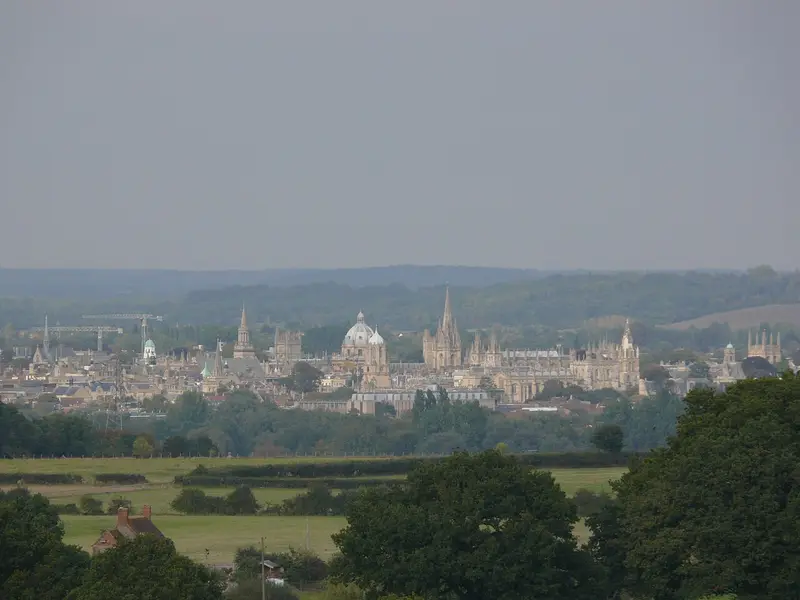
Oxford is the oldest university city in the United Kingdom, some 50 miles (80 km) to the west of the capital London in its own county of Oxfordshire, on the rivers Thames and Cherwell. — Wikivoyage, CC BY-SA 4.0
When to go: Oxford is warmest in August (17.1 °C), sunniest in June (12.5 h a day); coldest in January (4.7 °C). Month by month
Getting there
| From | Distance | By rail | Rail time | By air | Air time |
|---|---|---|---|---|---|
| Amsterdam | 426 km | 17.2 kg | 8h 6m | 107 kg | 4h 6m |
| Barcelona | 1,181 km | 40.2 kg | 14h 36m | 297 kg | 5h 6m |
| Berlin | 1,003 km | 34.1 kg | 14h 30m | 252 kg | 4h 48m |
| Brussels | 402 km | 16.1 kg | 6h 12m | 101 kg | 4h |
| Copenhagen | 1,006 km | 34.8 kg | 20h 6m | 253 kg | 4h 48m |
| Dublin | 381 km | — | — | 95.7 kg | 4h |
| Edinburgh | 484 km | 38.9 kg | 7h 54m | 222 kg | 4h 6m |
| Frankfurt | 719 km | 25.5 kg | 10h 18m | 181 kg | 4h 30m |
| Glasgow | 498 km | 40.0 kg | 8h 6m | 228 kg | 4h 12m |
| Leeds | 228 km | 18.3 kg | 4h 48m | 105 kg | 3h 48m |
| Lisbon | 1,573 km | 53.4 kg | 32h 6m | 396 kg | 5h 36m |
| Liverpool | 218 km | 17.5 kg | 4h 36m | 100 kg | 3h 48m |
| Madrid | 1,274 km | 43.9 kg | 18h 12m | 321 kg | 5h 12m |
| Manchester | 203 km | 16.3 kg | 4h 24m | 93.2 kg | 3h 48m |
| Milan | 1,037 km | 34.9 kg | 14h 54m | 261 kg | 4h 54m |
| Munich | 1,001 km | 33.7 kg | 13h 36m | 252 kg | 4h 48m |
| Newcastle | 359 km | 28.9 kg | 6h 24m | 165 kg | 4h |
| Oslo | 1,173 km | 40.7 kg | 29h 42m | 295 kg | 5h 6m |
| Paris | 412 km | 16.8 kg | 6h 30m | 104 kg | 4h |
| Prague | 1,112 km | 37.1 kg | 20h | 280 kg | 5h |
| Rome | 1,512 km | 49.0 kg | 18h 54m | 380 kg | 5h 30m |
| Sheffield | 182 km | 14.6 kg | 4h 6m | 83.4 kg | 3h 42m |
| Stockholm | 1,471 km | 48.9 kg | 26h 24m | 370 kg | 5h 30m |
| Vienna | 1,317 km | 43.1 kg | 18h 42m | 331 kg | 5h 18m |
| Warsaw | 1,520 km | 49.4 kg | 22h | 382 kg | 5h 30m |
| Zurich | 858 km | 29.6 kg | 12h | 216 kg | 4h 36m |
The year in Oxford
| Jan | Feb | Mar | Apr | May | Jun | Jul | Aug | Sep | Oct | Nov | Dec | |
|---|---|---|---|---|---|---|---|---|---|---|---|---|
| Temp °C | 4.7 | 6.9 | 7.4 | 8.9 | 13.1 | 16.2 | 16.5 | 17.1 | 15.7 | 12.0 | 7.4 | 7.2 |
| Sun h/day | 4.6 | 4.3 | 5.3 | 8.0 | 10.4 | 12.5 | 10.3 | 9.6 | 7.7 | 5.9 | 4.3 | 2.3 |
| Rain mm/day | 1.9 | 2.3 | 3.5 | 2.5 | 2.3 | 1.2 | 2.9 | 1.8 | 4.1 | 3.1 | 2.8 | 2.6 |
When to go
Oxford is warmest in August at 17.1 °C but brightest in June, averaging 12.5 hours of sun a day — the two do not always coincide, which is worth knowing before booking. Its coldest is January at 4.7 °C.
Three months worth booking
The same year of measurements, decided rather than tabulated. Each opens the map below on dates in that month.
Staying there
A hotel room in United Kingdom emits about 10.4 kg CO₂e per night under UK Government 2026 factors — a country average per occupied room, not this or any particular hotel. 7 nights in one room adds roughly 73 kg — about 5.0× the carbon of one person getting there by rail from Sheffield. Two sharing the room halve that share each; the journey does not halve.
Where to stay in Oxford
Places to stay in Oxford, United Kingdom, on a live map. Prices and availability come from Stay22 and its booking partners.
Search places to stay in Oxford →Opens the booking search in a new tab. Same partners as the map below.
Affiliate disclosure. A booking made through this map may earn 0xCarbon a commission, at no extra cost to you. It changes nothing above it: the emissions figures come from UK Government conversion factors and are computed before anyone is paid anything.See the method.
Distances are great-circle. Rail assumes international rail at 0.01135 kg CO₂e per passenger-km with a 1.3× track detour allowance; flights use 0.12576 kg per passenger-km including radiative forcing. Journey times are modelled, not timetabled. Full method.