Minya
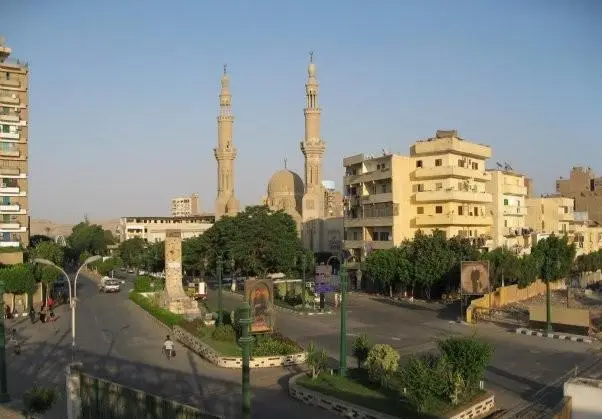

Minya is not costed by rail here: no through rail connection is modelled, and no verified rail or sea itinerary is included in this comparison. By air it is 920 kg CO₂e return from London. It averages 33.5 °C in July and 14.7 °C in January.
Minya is a city in Middle Egypt. — Wikivoyage, CC BY-SA 4.0
When to go: Minya is warmest in July (33.5 °C), sunniest in June (12.9 h a day); coldest in January (14.7 °C). Month by month
Getting there
Travel advice for Egypt. FCDO advises against all travel or all but essential travel to specified border, desert, North Sinai and South Sinai areas. gov.uk advice, page updated 4 August 2026; read 2026-09-15. Whether Minya itself is inside an affected area is not assessed here; check the page before booking.
| From | Distance | By rail | Rail time | By air | Air time |
|---|---|---|---|---|---|
| Amsterdam | 3,442 km | — | — | 866 kg | 8h 6m |
| Barcelona | 2,982 km | — | — | 750 kg | 7h 30m |
| Berlin | 3,071 km | — | — | 773 kg | 7h 36m |
| Birmingham | 3,817 km | — | — | 894 kg | 8h 36m |
| Bristol | 3,799 km | — | — | 889 kg | 8h 36m |
| Brussels | 3,361 km | — | — | 845 kg | 8h |
| Cardiff | 3,835 km | — | — | 898 kg | 8h 36m |
| Copenhagen | 3,393 km | — | — | 854 kg | 8h |
| Dublin | 4,117 km | — | — | 964 kg | 9h |
| Edinburgh | 4,101 km | — | — | 960 kg | 9h |
| Frankfurt | 3,078 km | — | — | 774 kg | 7h 36m |
| Glasgow | 4,150 km | — | — | 972 kg | 9h |
| Leeds | 3,878 km | — | — | 908 kg | 8h 42m |
| Lisbon | 3,854 km | — | — | 902 kg | 8h 36m |
| Liverpool | 3,933 km | — | — | 921 kg | 8h 42m |
| London | 3,656 km | — | — | 920 kg | 8h 24m |
| Madrid | 3,423 km | — | — | 861 kg | 8h 6m |
| Manchester | 3,896 km | — | — | 912 kg | 8h 42m |
| Milan | 2,707 km | — | — | 681 kg | 7h 6m |
| Munich | 2,773 km | — | — | 698 kg | 7h 12m |
| Newcastle | 3,957 km | — | — | 926 kg | 8h 48m |
| Nottingham | 3,804 km | — | — | 890 kg | 8h 36m |
| Oslo | 3,849 km | — | — | 901 kg | 8h 36m |
| Paris | 3,347 km | — | — | 842 kg | 8h |
| Prague | 2,809 km | — | — | 707 kg | 7h 12m |
| Rome | 2,253 km | — | — | 567 kg | 6h 30m |
| Sheffield | 3,848 km | — | — | 901 kg | 8h 36m |
| Southampton | 3,696 km | — | — | 930 kg | 8h 24m |
| Stockholm | 3,606 km | — | — | 907 kg | 8h 18m |
| Vienna | 2,557 km | — | — | 643 kg | 6h 54m |
| Warsaw | 2,803 km | — | — | 705 kg | 7h 12m |
| Zurich | 2,879 km | — | — | 724 kg | 7h 18m |
The year in Minya
| Jan | Feb | Mar | Apr | May | Jun | Jul | Aug | Sep | Oct | Nov | Dec | |
|---|---|---|---|---|---|---|---|---|---|---|---|---|
| Temp °C | 14.7 | 15.0 | 20.0 | 24.7 | 28.2 | 32.9 | 33.5 | 33.1 | 31.0 | 25.9 | 21.1 | 16.4 |
| Sun h/day | 9.7 | 9.9 | 11.2 | 11.7 | 11.8 | 12.9 | 12.9 | 12.0 | 11.8 | 10.7 | 9.9 | 9.8 |
| Rain mm/day | 0.0 | 0.0 | 0.0 | 0.0 | 0.1 | 0.0 | 0.0 | 0.0 | 0.0 | 0.0 | 0.0 | 0.0 |
When to go
Minya is warmest in July at 33.5 °C but brightest in June, averaging 12.9 hours of sun a day — the two do not always coincide, which is worth knowing before booking. Its coldest is January at 14.7 °C.
Three months worth booking
The same year of measurements, decided rather than tabulated. Each opens the map below on dates in that month.
Staying there
A hotel room in Egypt emits about 44.2 kg CO₂e per night under UK Government 2026 factors — a country average per occupied room, not this or any particular hotel. 7 nights in one room adds roughly 309 kg — worth weighing against the 920 kg of one person's flight. Two sharing the room halve that share each; the journey does not halve.
Where to stay in Minya
Places to stay in Minya, Egypt, on a live map. Prices and availability come from Stay22 and its booking partners.
Search places to stay in Minya →Opens the booking search in a new tab. Same partners as the map below.
Affiliate disclosure. A booking made through this map may earn 0xCarbon a commission, at no extra cost to you. It changes nothing above it: the emissions figures come from UK Government conversion factors and are computed before anyone is paid anything.See the method.
Distances are great-circle. Rail assumes international rail at 0.01135 kg CO₂e per passenger-km with a 1.3× track detour allowance; flights use 0.12576 kg per passenger-km including radiative forcing. Journey times are modelled, not timetabled. Full method.