Karlskrona

Reaching Karlskrona from London emits 34.0 kg CO₂e return by rail (18h 48m each way) against 289 kg by air — 9× the carbon. It averages 17.1 °C in August and 0.8 °C in January.
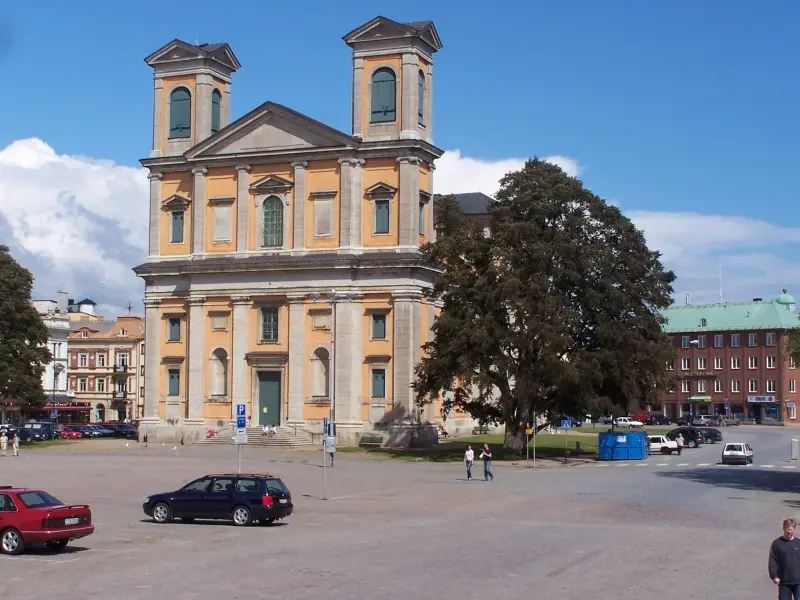
Karlskrona, archaic spelling Carlskrona, is a city in Blekinge in southern Sweden. — Wikivoyage, CC BY-SA 4.0
When to go: Karlskrona is warmest in August (17.1 °C), sunniest in May (14.2 h a day); coldest in January (0.8 °C). Month by month
Getting there
| From | Distance | By rail | Rail time | By air | Air time |
|---|---|---|---|---|---|
| Amsterdam | 811 km | 23.9 kg | 13h 42m | 204 kg | 4h 36m |
| Barcelona | 1,907 km | 56.3 kg | 25h 36m | 480 kg | 6h |
| Berlin | 428 km | 12.6 kg | 8h 12m | 108 kg | 4h 6m |
| Birmingham | 1,202 km | 47.0 kg | 21h 36m | 302 kg | 5h 6m |
| Bristol | 1,299 km | 47.7 kg | 21h 48m | 327 kg | 5h 12m |
| Brussels | 947 km | 28.0 kg | 15h 42m | 238 kg | 4h 48m |
| Cardiff | 1,332 km | 50.9 kg | 22h 6m | 335 kg | 5h 18m |
| Copenhagen | 196 km | 5.8 kg | 4h 48m | 49.3 kg | 3h 48m |
| Dublin | 1,430 km | — | — | 360 kg | 5h 24m |
| Edinburgh | 1,163 km | 76.8 kg | 24h 36m | 293 kg | 5h 6m |
| Frankfurt | 814 km | 24.0 kg | 12h 48m | 205 kg | 4h 36m |
| Glasgow | 1,230 km | 78.6 kg | 24h 42m | 309 kg | 5h 6m |
| Leeds | 1,121 km | 55.8 kg | 22h 24m | 282 kg | 5h |
| Lisbon | 2,659 km | 78.5 kg | 40h 24m | 669 kg | 7h |
| Liverpool | 1,225 km | 57.0 kg | 22h 24m | 308 kg | 5h 6m |
| London | 1,150 km | 34.0 kg | 18h 48m | 289 kg | 5h |
| Madrid | 2,243 km | 66.2 kg | 29h 12m | 564 kg | 6h 30m |
| Manchester | 1,176 km | 55.0 kg | 22h 18m | 296 kg | 5h 6m |
| Milan | 1,270 km | 37.5 kg | 20h 18m | 320 kg | 5h 12m |
| Munich | 933 km | 27.5 kg | 12h 36m | 235 kg | 4h 42m |
| Newcastle | 1,087 km | 65.9 kg | 23h 6m | 273 kg | 4h 54m |
| Nottingham | 1,133 km | 48.0 kg | 21h 54m | 285 kg | 5h |
| Oslo | 505 km | 14.9 kg | 9h 18m | 127 kg | 4h 12m |
| Paris | 1,206 km | 35.6 kg | 17h 30m | 303 kg | 5h 6m |
| Prague | 680 km | 20.1 kg | 11h 48m | 171 kg | 4h 24m |
| Rome | 1,602 km | 47.3 kg | 23h 48m | 403 kg | 5h 36m |
| Sheffield | 1,133 km | 52.2 kg | 22h 12m | 285 kg | 5h |
| Southampton | 1,261 km | 42.9 kg | 21h 30m | 317 kg | 5h 12m |
| Stockholm | 382 km | 11.3 kg | 7h | 96.0 kg | 4h |
| Vienna | 886 km | 26.1 kg | 14h 48m | 223 kg | 4h 42m |
| Warsaw | 562 km | 16.6 kg | 9h 36m | 141 kg | 4h 12m |
| Zurich | 1,090 km | 32.2 kg | 17h 18m | 274 kg | 5h |
The year in Karlskrona
| Jan | Feb | Mar | Apr | May | Jun | Jul | Aug | Sep | Oct | Nov | Dec | |
|---|---|---|---|---|---|---|---|---|---|---|---|---|
| Temp °C | 0.8 | 2.3 | 3.0 | 6.2 | 13.1 | 16.4 | 16.9 | 17.1 | 15.8 | 9.8 | 4.3 | 2.8 |
| Sun h/day | 3.1 | 4.1 | 6.1 | 9.7 | 14.2 | 13.7 | 13.0 | 10.7 | 9.5 | 5.6 | 3.4 | 1.7 |
| Rain mm/day | 3.4 | 2.0 | 1.6 | 1.2 | 0.6 | 2.3 | 4.6 | 2.2 | 2.1 | 3.2 | 1.8 | 1.7 |
| Sea °C | 4.0 | 3.6 | 3.4 | 4.5 | 8.3 | 14.0 | 15.6 | 15.3 | 16.1 | 11.5 | 8.3 | 5.5 |
When to go
Karlskrona is warmest in August at 17.1 °C but brightest in May, averaging 14.2 hours of sun a day — the two do not always coincide, which is worth knowing before booking. Its coldest is January at 0.8 °C.
Three months worth booking
The same year of measurements, decided rather than tabulated. Each opens the map below on dates in that month.
Where to stay in Karlskrona
Places to stay in Karlskrona, Sweden, on a live map. Prices and availability come from Stay22 and its booking partners.
Search places to stay in Karlskrona →Opens the booking search in a new tab. Same partners as the map below.
Affiliate disclosure. A booking made through this map may earn 0xCarbon a commission, at no extra cost to you. It changes nothing above it: the emissions figures come from UK Government conversion factors and are computed before anyone is paid anything.See the method.
Distances are great-circle. Rail assumes international rail at 0.01135 kg CO₂e per passenger-km with a 1.3× track detour allowance; flights use 0.12576 kg per passenger-km including radiative forcing. Journey times are modelled, not timetabled. Full method.