Jelgava

Reaching Jelgava from London emits 48.6 kg CO₂e return by rail (32h 36m each way) against 414 kg by air — 9× the carbon. It averages 18.7 °C in August and -2.2 °C in January.
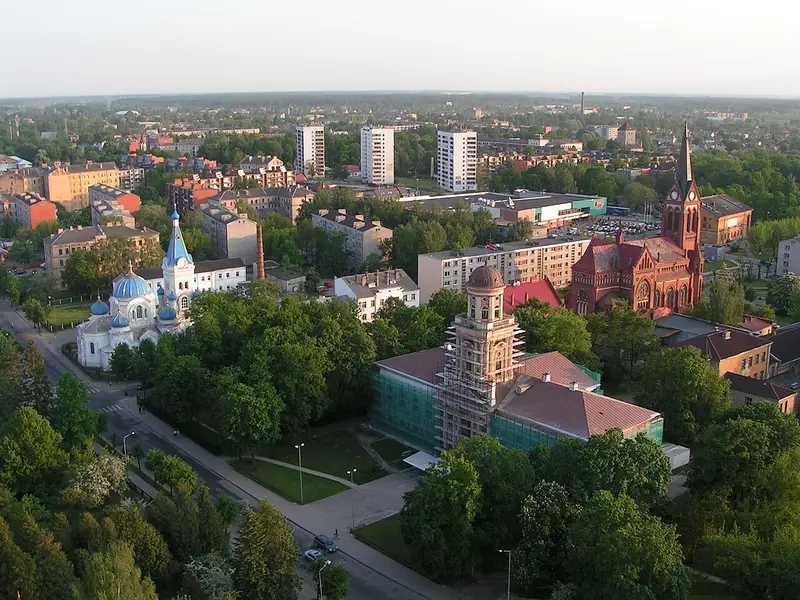
Jelgava (German: Mitau) is a city in Latvia about 41 km southwest of Riga. — Wikivoyage, CC BY-SA 4.0
When to go: Jelgava is warmest in August (18.7 °C), sunniest in May (13.8 h a day); coldest in January (-2.2 °C). Month by month
Getting there
| From | Distance | By rail | Rail time | By air | Air time |
|---|---|---|---|---|---|
| Amsterdam | 1,300 km | 38.4 kg | 27h 24m | 327 kg | 5h 12m |
| Barcelona | 2,294 km | 67.7 kg | 38h 30m | 577 kg | 6h 36m |
| Berlin | 806 km | 23.8 kg | 20h 36m | 203 kg | 4h 36m |
| Birmingham | 1,704 km | 61.7 kg | 35h 18m | 429 kg | 5h 48m |
| Bristol | 1,799 km | 62.3 kg | 35h 36m | 452 kg | 5h 54m |
| Brussels | 1,420 km | 41.9 kg | 28h 54m | 357 kg | 5h 24m |
| Cardiff | 1,833 km | 65.6 kg | 35h 54m | 461 kg | 5h 54m |
| Copenhagen | 698 km | 20.6 kg | 18h 24m | 176 kg | 4h 24m |
| Dublin | 1,930 km | — | — | 486 kg | 6h 6m |
| Edinburgh | 1,651 km | 91.5 kg | 38h 18m | 415 kg | 5h 42m |
| Frankfurt | 1,229 km | 36.3 kg | 25h 54m | 309 kg | 5h 6m |
| Glasgow | 1,718 km | 93.2 kg | 38h 30m | 432 kg | 5h 48m |
| Leeds | 1,623 km | 70.5 kg | 36h 12m | 408 kg | 5h 42m |
| Lisbon | 3,115 km | 91.9 kg | 56h | 784 kg | 7h 42m |
| Liverpool | 1,727 km | 71.6 kg | 36h 12m | 434 kg | 5h 48m |
| London | 1,647 km | 48.6 kg | 32h 36m | 414 kg | 5h 42m |
| Madrid | 2,675 km | 78.9 kg | 42h 6m | 673 kg | 7h 6m |
| Manchester | 1,679 km | 69.6 kg | 36h 6m | 422 kg | 5h 42m |
| Milan | 1,599 km | 47.2 kg | 34h 24m | 402 kg | 5h 36m |
| Munich | 1,251 km | 36.9 kg | 25h 30m | 315 kg | 5h 12m |
| Newcastle | 1,584 km | 80.6 kg | 36h 48m | 399 kg | 5h 36m |
| Nottingham | 1,636 km | 62.7 kg | 35h 42m | 411 kg | 5h 42m |
| Oslo | 839 km | 24.7 kg | 19h 6m | 211 kg | 4h 36m |
| Paris | 1,669 km | 49.2 kg | 30h 24m | 420 kg | 5h 42m |
| Prague | 954 km | 28.1 kg | 24h 30m | 240 kg | 4h 48m |
| Rome | 1,826 km | 53.9 kg | 38h 24m | 459 kg | 5h 54m |
| Sheffield | 1,636 km | 66.9 kg | 36h | 411 kg | 5h 42m |
| Southampton | 1,757 km | 57.6 kg | 35h 18m | 442 kg | 5h 48m |
| Stockholm | 446 km | 13.2 kg | 12h 36m | 112 kg | 4h 6m |
| Vienna | 1,061 km | 31.3 kg | 21h 54m | 267 kg | 4h 54m |
| Warsaw | 522 km | 15.4 kg | 14h 18m | 131 kg | 4h 12m |
| Zurich | 1,458 km | 43.0 kg | 30h 12m | 367 kg | 5h 24m |
The year in Jelgava
| Jan | Feb | Mar | Apr | May | Jun | Jul | Aug | Sep | Oct | Nov | Dec | |
|---|---|---|---|---|---|---|---|---|---|---|---|---|
| Temp °C | -2.2 | 0.7 | 3.2 | 7.9 | 13.8 | 17.6 | 18.3 | 18.7 | 16.5 | 8.4 | 3.4 | 0.7 |
| Sun h/day | 1.7 | 2.8 | 6.0 | 8.3 | 13.8 | 13.8 | 12.7 | 11.4 | 10.0 | 5.0 | 2.9 | 1.2 |
| Rain mm/day | 2.0 | 1.7 | 1.3 | 1.7 | 1.0 | 2.9 | 5.2 | 3.3 | 1.6 | 2.0 | 1.4 | 1.3 |
When to go
Jelgava is warmest in August at 18.7 °C but brightest in May, averaging 13.8 hours of sun a day — the two do not always coincide, which is worth knowing before booking. Its coldest is January at -2.2 °C.
Three months worth booking
The same year of measurements, decided rather than tabulated. Each opens the map below on dates in that month.
How busy it gets
Zemgale records 0.9 overnight stays per resident a year (191,739 nights in 2024). Comparatively quiet by European standards.
Eurostat, nights spent at tourist accommodation by NUTS 3 region, against resident population. Shown for context only — it plays no part in which destinations appear or in what order. Eurostat does not cover the United Kingdom after 2016, nor North Africa or the Levant at all, so this figure is absent for roughly a third of the destinations here.
Where to stay in Jelgava
Places to stay in Jelgava, Latvia, on a live map. Prices and availability come from Stay22 and its booking partners.
Search places to stay in Jelgava →Opens the booking search in a new tab. Same partners as the map below.
Affiliate disclosure. A booking made through this map may earn 0xCarbon a commission, at no extra cost to you. It changes nothing above it: the emissions figures come from UK Government conversion factors and are computed before anyone is paid anything.See the method.
Distances are great-circle. Rail assumes international rail at 0.01135 kg CO₂e per passenger-km with a 1.3× track detour allowance; flights use 0.12576 kg per passenger-km including radiative forcing. Journey times are modelled, not timetabled. Full method.