Esna
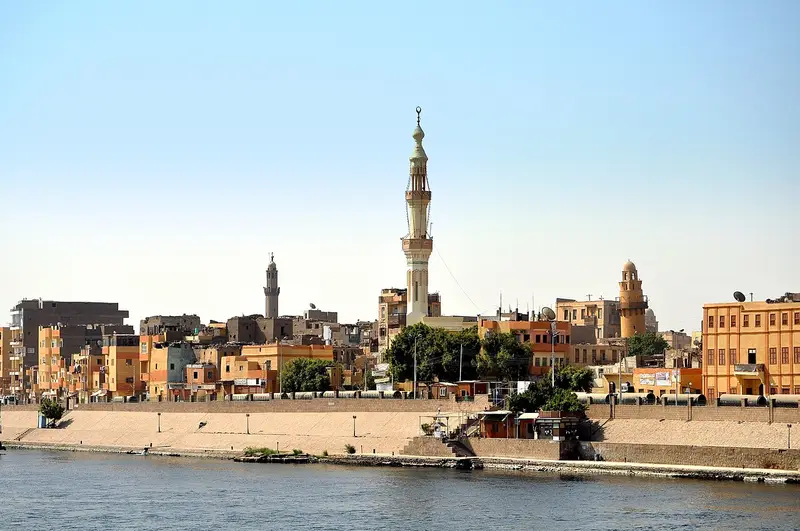

Esna is not costed by rail here: no through rail connection is modelled, and no verified rail or sea itinerary is included in this comparison. By air it is 939 kg CO₂e return from London. It averages 36.5 °C in August and 17.2 °C in January.
Esna is an Egyptian town in the region of Upper Egypt. — Wikivoyage, CC BY-SA 4.0
When to go: Esna is warmest in August (36.5 °C), sunniest in June (12.6 h a day); coldest in January (17.2 °C). Month by month
Getting there
Travel advice for Egypt. FCDO advises against all travel or all but essential travel to specified border, desert, North Sinai and South Sinai areas. gov.uk advice, page updated 4 August 2026; read 2026-09-15. Whether Esna itself is inside an affected area is not assessed here; check the page before booking.
| From | Distance | By rail | Rail time | By air | Air time |
|---|---|---|---|---|---|
| Amsterdam | 3,801 km | — | — | 890 kg | 8h 36m |
| Barcelona | 3,316 km | — | — | 834 kg | 7h 54m |
| Berlin | 3,427 km | — | — | 862 kg | 8h 6m |
| Birmingham | 4,174 km | — | — | 977 kg | 9h 6m |
| Bristol | 4,154 km | — | — | 973 kg | 9h |
| Brussels | 3,719 km | — | — | 871 kg | 8h 30m |
| Cardiff | 4,191 km | — | — | 981 kg | 9h 6m |
| Copenhagen | 3,747 km | — | — | 877 kg | 8h 30m |
| Dublin | 4,473 km | — | — | 1,047 kg | 9h 30m |
| Edinburgh | 4,460 km | — | — | 1,044 kg | 9h 24m |
| Frankfurt | 3,436 km | — | — | 864 kg | 8h 6m |
| Glasgow | 4,509 km | — | — | 1,056 kg | 9h 30m |
| Leeds | 4,236 km | — | — | 992 kg | 9h 6m |
| Lisbon | 4,164 km | — | — | 975 kg | 9h 6m |
| Liverpool | 4,291 km | — | — | 1,004 kg | 9h 12m |
| London | 4,013 km | — | — | 939 kg | 8h 54m |
| Madrid | 3,746 km | — | — | 877 kg | 8h 30m |
| Manchester | 4,254 km | — | — | 996 kg | 9h 12m |
| Milan | 3,063 km | — | — | 770 kg | 7h 36m |
| Munich | 3,132 km | — | — | 788 kg | 7h 42m |
| Newcastle | 4,315 km | — | — | 1,010 kg | 9h 18m |
| Nottingham | 4,161 km | — | — | 974 kg | 9h |
| Oslo | 4,200 km | — | — | 983 kg | 9h 6m |
| Paris | 3,702 km | — | — | 867 kg | 8h 24m |
| Prague | 3,167 km | — | — | 796 kg | 7h 42m |
| Rome | 2,605 km | — | — | 655 kg | 7h |
| Sheffield | 4,206 km | — | — | 985 kg | 9h 6m |
| Southampton | 4,052 km | — | — | 948 kg | 8h 54m |
| Stockholm | 3,948 km | — | — | 924 kg | 8h 48m |
| Vienna | 2,914 km | — | — | 733 kg | 7h 24m |
| Warsaw | 3,149 km | — | — | 792 kg | 7h 42m |
| Zurich | 3,236 km | — | — | 814 kg | 7h 48m |
The year in Esna
| Jan | Feb | Mar | Apr | May | Jun | Jul | Aug | Sep | Oct | Nov | Dec | |
|---|---|---|---|---|---|---|---|---|---|---|---|---|
| Temp °C | 17.2 | 17.7 | 23.1 | 27.8 | 31.3 | 36.1 | 36.0 | 36.5 | 33.9 | 28.8 | 23.3 | 18.6 |
| Sun h/day | 10.0 | 10.2 | 11.4 | 11.8 | 11.9 | 12.6 | 12.3 | 11.9 | 11.6 | 11.0 | 10.6 | 10.0 |
| Rain mm/day | 0.0 | 0.0 | 0.0 | 0.0 | 0.0 | 0.0 | 0.0 | 0.0 | 0.0 | 0.0 | 0.0 | 0.0 |
When to go
Esna is warmest in August at 36.5 °C but brightest in June, averaging 12.6 hours of sun a day — the two do not always coincide, which is worth knowing before booking. Its coldest is January at 17.2 °C.
Three months worth booking
The same year of measurements, decided rather than tabulated. Each opens the map below on dates in that month.
Staying there
A hotel room in Egypt emits about 44.2 kg CO₂e per night under UK Government 2026 factors — a country average per occupied room, not this or any particular hotel. 7 nights in one room adds roughly 309 kg — worth weighing against the 939 kg of one person's flight. Two sharing the room halve that share each; the journey does not halve.
Where to stay in Esna
Places to stay in Esna, Egypt, on a live map. Prices and availability come from Stay22 and its booking partners.
Search places to stay in Esna →Opens the booking search in a new tab. Same partners as the map below.
Affiliate disclosure. A booking made through this map may earn 0xCarbon a commission, at no extra cost to you. It changes nothing above it: the emissions figures come from UK Government conversion factors and are computed before anyone is paid anything.See the method.
Distances are great-circle. Rail assumes international rail at 0.01135 kg CO₂e per passenger-km with a 1.3× track detour allowance; flights use 0.12576 kg per passenger-km including radiative forcing. Journey times are modelled, not timetabled. Full method.