Buxton
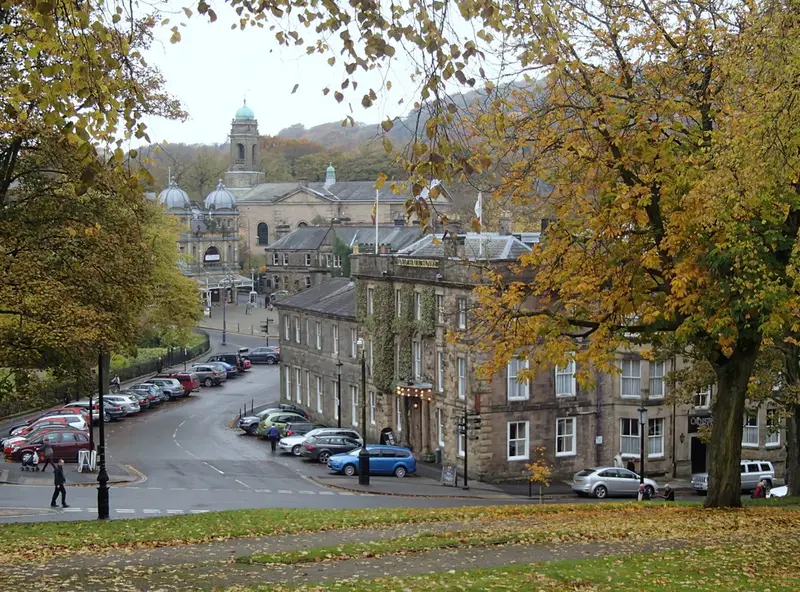

Reaching Buxton from London emits 18.4 kg CO₂e return by rail (4h 36m each way) against 105 kg by air — 6× the carbon. It averages 13.9 °C in August and 3.0 °C in January.
Buxton is an ancient spa town in the Peak District, England. — Wikivoyage, CC BY-SA 4.0
When to go: Buxton is warmest in August (13.9 °C), sunniest in June (11.6 h a day); coldest in January (3.0 °C). Month by month
Getting there
| From | Distance | By rail | Rail time | By air | Air time |
|---|---|---|---|---|---|
| Amsterdam | 467 km | 29.0 kg | 10h 12m | 118 kg | 4h 6m |
| Barcelona | 1,354 km | 52.0 kg | 16h 42m | 341 kg | 5h 18m |
| Berlin | 1,029 km | 45.9 kg | 16h 36m | 259 kg | 4h 54m |
| Bristol | 206 km | 16.5 kg | 4h 30m | 94.3 kg | 3h 48m |
| Brussels | 504 km | 27.9 kg | 8h 18m | 127 kg | 4h 12m |
| Cardiff | 216 km | 17.3 kg | 4h 36m | 98.9 kg | 3h 48m |
| Copenhagen | 971 km | 46.6 kg | 22h 12m | 244 kg | 4h 48m |
| Dublin | 288 km | — | — | 72.6 kg | 3h 54m |
| Edinburgh | 311 km | 25.0 kg | 6h | 143 kg | 3h 54m |
| Frankfurt | 809 km | 37.2 kg | 12h 24m | 203 kg | 4h 36m |
| Glasgow | 327 km | 26.3 kg | 5h 48m | 150 kg | 3h 54m |
| Lisbon | 1,708 km | 65.2 kg | 34h 12m | 430 kg | 5h 48m |
| London | 229 km | 18.4 kg | 4h 36m | 105 kg | 3h 48m |
| Madrid | 1,434 km | 55.7 kg | 20h 18m | 361 kg | 5h 24m |
| Milan | 1,179 km | 46.7 kg | 17h | 297 kg | 5h 6m |
| Munich | 1,105 km | 45.5 kg | 15h 42m | 278 kg | 5h |
| Newcastle | 192 km | 15.4 kg | 4h 18m | 87.9 kg | 3h 48m |
| Oslo | 1,068 km | 52.5 kg | 31h 48m | 269 kg | 4h 54m |
| Paris | 573 km | 28.6 kg | 8h 36m | 144 kg | 4h 18m |
| Prague | 1,177 km | 48.9 kg | 22h 6m | 296 kg | 5h 6m |
| Rome | 1,657 km | 60.8 kg | 21h | 417 kg | 5h 42m |
| Southampton | 264 km | 21.2 kg | 5h 18m | 121 kg | 3h 54m |
| Stockholm | 1,398 km | 60.7 kg | 28h 30m | 352 kg | 5h 24m |
| Vienna | 1,399 km | 54.9 kg | 20h 48m | 352 kg | 5h 24m |
| Warsaw | 1,541 km | 61.2 kg | 24h 6m | 388 kg | 5h 36m |
| Zurich | 989 km | 41.4 kg | 14h 6m | 249 kg | 4h 48m |
The year in Buxton
| Jan | Feb | Mar | Apr | May | Jun | Jul | Aug | Sep | Oct | Nov | Dec | |
|---|---|---|---|---|---|---|---|---|---|---|---|---|
| Temp °C | 3.0 | 4.9 | 4.7 | 6.4 | 11.1 | 12.9 | 13.5 | 13.9 | 12.8 | 9.4 | 5.1 | 4.9 |
| Sun h/day | 3.5 | 3.6 | 5.0 | 7.4 | 10.4 | 11.6 | 9.7 | 9.6 | 7.1 | 5.0 | 3.9 | 2.0 |
| Rain mm/day | 3.2 | 2.5 | 4.3 | 3.9 | 2.8 | 2.2 | 4.7 | 2.4 | 3.9 | 4.6 | 2.7 | 4.6 |
When to go
Buxton is warmest in August at 13.9 °C but brightest in June, averaging 11.6 hours of sun a day — the two do not always coincide, which is worth knowing before booking. Its coldest is January at 3.0 °C.
On these lists
- Coolest from London in June · #4
- Coolest from London in April · #2 by train
- Coolest from London in May · #3 by train
- Coolest from London in March · #4 by train
- Coolest from London in July · low-carbon pick
- Coolest from London in August · low-carbon pick
- Coolest from London in September · low-carbon pick
- Coolest from London in October · low-carbon pick
Three months worth booking
The same year of measurements, decided rather than tabulated. Each opens the map below on dates in that month.
Staying there
A hotel room in United Kingdom emits about 10.4 kg CO₂e per night under UK Government 2026 factors — a country average per occupied room, not this or any particular hotel. 7 nights in one room adds roughly 73 kg — about 4.7× the carbon of one person getting there by rail from Newcastle. Two sharing the room halve that share each; the journey does not halve.
Where to stay in Buxton
Places to stay in Buxton, United Kingdom, on a live map. Prices and availability come from Stay22 and its booking partners.
Search places to stay in Buxton →Opens the booking search in a new tab. Same partners as the map below.
Affiliate disclosure. A booking made through this map may earn 0xCarbon a commission, at no extra cost to you. It changes nothing above it: the emissions figures come from UK Government conversion factors and are computed before anyone is paid anything.See the method.
Distances are great-circle. Rail assumes international rail at 0.01135 kg CO₂e per passenger-km with a 1.3× track detour allowance; flights use 0.12576 kg per passenger-km including radiative forcing. Journey times are modelled, not timetabled. Full method.